The Hospital-to-Shelter Bridge Initiative (HSBI) is a student-founded, medically oriented program designed to close the dangerous gap between hospital emergency departments and domestic violence shelters.
Every year, survivors arrive at ERs seeking help only to be discharged into unstable, unsafe, or violent environments due to a lack of real-time shelter information, transportation barriers, and fragmented communication between providers. Social workers spend hours calling shelters with no answer, shelters struggle to coordinate with hospitals, and survivors ultimately fall through the cracks.
HSBI addresses these failures by building a centralized, continuously updated Domestic Violence Resource Map that includes:
Shelter availability and eligibility
SANE nurse locations
Advocacy organizations
Free and low-cost medical clinics
ER social work contacts
Transportation resources

'"कितनी गिरह?” (How many more Knots?)' from the 'A Thousand Cuts' series by Sujata Setia
Credit: Sujata Setia/Sony World Photography Awards

Artwork by Jennifer Zabek
The Mission
To ensure every domestic violence survivor who enters a hospital is safely connected to emergency housing, medical care, and advocacy support through coordinated, trauma-informed partnerships between shelters and healthcare systems.
The Vision
A healthcare system where no survivor is discharged back into danger, and where hospitals and shelters operate as a unified network to protect survivors at their most vulnerable moments.
PERCENTAGES AND FACTS:
National research makes one thing unmistakably clear: domestic violence is not a “one-time escape”, it is a recurring, system-shaped cycle. Studies show that 66.3% of survivors in shelters had already left and returned to their abuser at least once, and 97.1% of those had returned multiple times. Broader national data shows survivors will attempt to leave an average of 6–7 times before they can separate for good, with 88.3% reporting at least two prior attempts and 33.5% attempting five or more separations. Housing instability is the driving factor: over 50% of survivors become homeless at some point after leaving, and a shocking 38% return to their abuser simply because they have no safe place to go that same day. Hospitals are often the moment survivors reach out for help, yet more than 70% leave the ER with no formal safety plan and no guaranteed shelter placement. These statistics reveal a preventable truth: survivors aren’t “choosing” to return. Systems are pushing them back.
The Hospital-to-Shelter Bridge Initiative (HSBI) is designed to intervene at the exact moment when survivors are most vulnerable to returning: the hospital discharge. By giving ER social workers a direct line to shelter beds, transportation options, and follow-up medical pathways, HSBI eliminates the “gap hours” where survivors typically fall through the cracks. A safe bed within hours — not days — dramatically reduces the likelihood of returning to an abuser. Research shows that when survivors secure safe housing immediately, their odds of breaking the cycle long-term increase substantially. HSBI doesn’t just coordinate care; it strategically targets one of the strongest predictors of returning to abuse and replaces it with stability, protection, and continuity of healthcare.
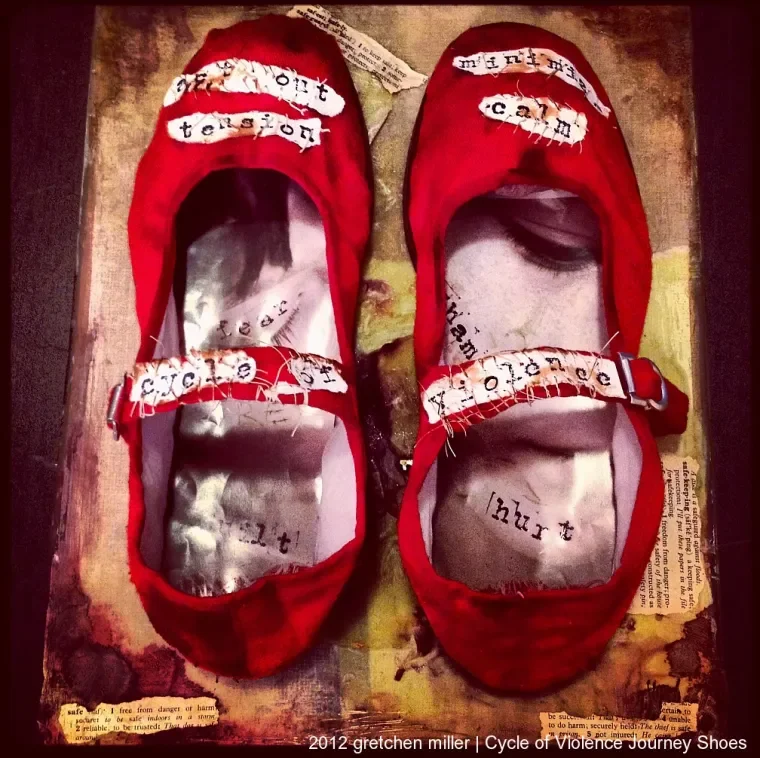
Journey Shoes: Cycle of Violence